
YES Media Arts Students in the News
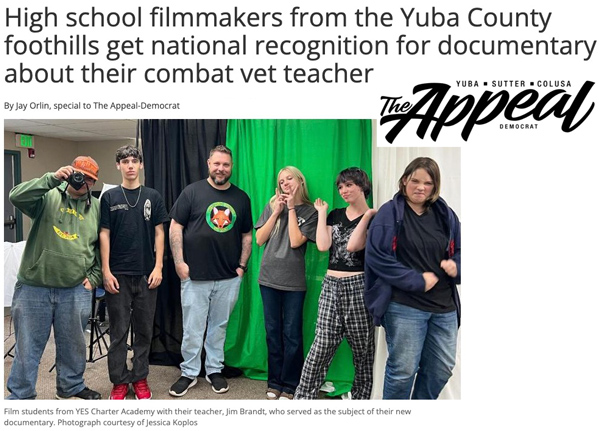
Some creative young personalities at YES Charter Academy in Oregon House are celebrating their very first class film project by getting accepted to the Mosaic World Film Festival.
These students of media arts produced a short documentary that tells the story of their teacher, Jim Brandt, whose life took a dramatic turn after he was wounded while serving in the U.S. Army’s 82nd Airborne in Afghanistan. Following his recovery, Brandt found a new path in education, eventually becoming a teacher at Yuba County’s free public charter school for K-12 learners.
For the students, documenting Brandt’s journey became both a filmmaking project and an opportunity to understand the person behind the teacher in their classroom. Their film about the instructor is called “From Combat to Classroom.”
“The experience taught me the meaning of leadership and having responsibility for the lives of others,” Brandt recalled. “When I left the service, I found myself missing the feeling of responsibility, of impacting others in a positive way. It shaped who I am as a person and the teacher I am today.”
The students called their group the Blac Jam Studio production team. It’s comprised of Jackson Milligan, the director, Faithlynn Bartell Adams, the producer, Alex Butterworth, the editor, Mason Carter, the interviewer, Abigail Van unen and Violeta Gentry-Morales, the camera operators, Richard Aguirre, handling sound duties and Camden Lage, working with lighting. In assembling it and launching their mission, the team members learned the fundamentals of documentary filmmaking, including scripting questions, interviewing, camera operation, sound recording, storytelling and editing. The project gave them hands-on experience creating the film from concept to completion. Their work has now moved beyond the classroom, with the documentary being selected for the Mosaic World Film Festival.
Media arts is one of three Career Technical Education (CTE) pathways offered at YES Charter Academy. These CTE concentrations give students opportunities to develop practical skills, explore potential careers and create work that connects classroom learning with real-world experience.
The journey also reflects something distinctive about YES Charter Academy: A belief that learning is often built around relationships, individual interests and opportunities for students to take ownership of their work.
Fans of the school say that, under the leadership of Principal Louise Miller, it has cultivated a community where students are encouraged to discover what they are capable of doing and to see their education as preparation for life beyond the classroom. This approach reportedly creates room for students to take risks, try something new and learn through doing.
The academy’s media arts teacher, Jessica Koplos, is an experienced producer with credits from Disney, CBS, MTV and HBO, as well as producing films for the San Francisco Opera. She leverages her connections to provide students with access to working professionals for advice and encouragement.
“Having their first film project accepted at a national film festival is an impressive accomplishment,” Koplos noted of her students. “I am delighted for Blac Jam Studio team members! I am also very proud of their tenacity, their collective creativity and trusting that creativity. And their skills in collaboration got them across the complex ‘finish line’ which is now recognized nationally as good storytelling with film.”
That philosophy meant the team members weren’t simply completing a project, they were functioning as a production team with real responsibilities. Each student had a role in bringing the film to life, and the finished film became a shared accomplishment, with a shared sense of purpose. The process required collaboration, communication and problem solving, while giving students the opportunity to see their individual contribution become part of a larger project.
Blac Jam members shared something of their experience and the role they played.
“Mr. Brandt is a hero to me.” Blanc Jam member Richard Aguirre shared. “I was surprised when the film was accepted to the festival.”
Student Faithlynn Bartell Adams had similar feelings.
“Mr. Brandt inspired me to be more of me,” she reflected. “He’s my favorite teacher.”
For student Camden Lage, what stood out about Blanc Jam’s big accomplishment was overcoming hurdles.
“I didn’t realize how adaptable you have to be to make a film,” Lage acknowledged.
Team member Alex Butterworth agreed.
“The editing was very challenging,” Butterworth pointed out, “but I was able to push through it.”
The Mosaic World Film Festival ultimately provided a professional setting for all of these first-year filmmakers – and one that was on a national level. ”From Combat to Classroom” was screened there on September 19.
“I’m so proud of the students and the teachers who inspired and guided them,” Miller said. “First year YES Media Arts students grew in confidence and skill and produced a film festival quality film. I’m thrilled that the YES Media Arts CTE pathway empowers students to build a bright future.”